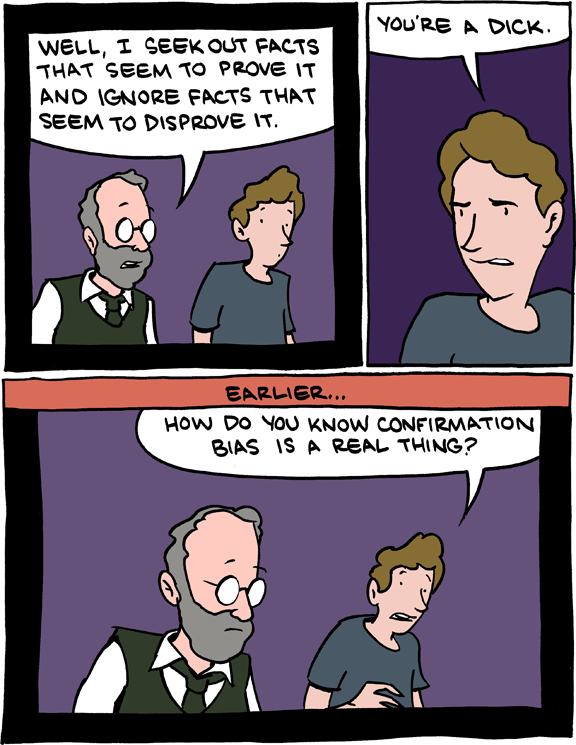
Clay Johnson spends a fair amount of time discussing the concept of affirmation in his outline for the information diet, and it's easy to see why. The amount of information we find in our stream of news is constantly being rephrased, spun, and presented from different angles to get our attention and ensure we'll pay attention to what is being said, rather than what could be integral information. Sometimes, we'll see this kind of context or background detail left out to give the story a different angle and appeal to a certain crowd, thus leading them to pay more attention to the news outlet in the future and increase the revenue of the outlet through advertising, subscriptions, or other ways.
This pattern has only been enhanced by the advent of the Internet and the hyperlink. With how our social media is constructed, it has been made that much easier to only pay attention to the news sources we care about and want to hear, making it easier to neglect other viewpoints or even basic information. Adamic makes this point in discussing "The social hyperlink", after several studies and an amount of research that most political bloggers only link to blogs that support their own viewpoints, stating, "One possible explanation is that bloggers are primarily seeking validation for their own ideas and lending support to to similar blogs. Another likely explanation is that they are limiting their own exposure to opposing point so view by selectively reading the posts of those blogs they are already in agreement with." This lends support to the idea that we favor the information that is unchallenging to us, which goes exactly against the idea of the information diet.
An article like this goes into depth about what this kind of thing means. In fact, finding this article was actually somewhat difficult, as there isn't a great amount of information on the subject. There is a collection of information on bias featured in news outlets, but less so on how we consume this kind of information and what that says about us. As they say, the first step is admitting you have a problem.
In dieting, one has to make sacrifices they don't want to make, but it's a necessary part of the concept of dieting. The same principle applies to the information diet, in that while affirmation may "taste" good, it isn't exactly healthy for the mind. One should limit it, even if they're not dieting.
Turow, J., Tsui, L., & Adamic, L. (2008). The social hyperlink. The hyperlinked society questioning connections in the digital age (pp. 227-249). Ann Arbor: University of Michigan Press :.
Image from Saturday Morning Breakfast Cereal [link].

No comments:
Post a Comment